Deferred Maintenance:
Novato's Quiet Emergency
This page is not an active campaign. It is a proposed future initiative. Novato Stewards is currently focused on NUSD parcel tax reform ahead of the June 2, 2026 ballot. The infrastructure bond described below is our next priority and remains in the research and development phase.
Novato has $55 million in documented infrastructure needs. Bad roads alone cost the average household $1,200 to $2,000 a year in vehicle damage. Below is our preliminary case for a voter-approved, time-limited general obligation bond that would cost roughly $150 per year per household and actually fix the problem. For our current active campaign, see NUSD Parcel Tax Reform.
Key Facts at a Glance
Total documented backlog: $55+ million across streets, parks, and buildings
Street PCI: Dropped from 68 (2020) to 63 (2024), now below the Bay Area average of 67 and just 3 points above the "At Risk" threshold
Unfunded street backlog alone: ~$40 million
Parks capital needs: $13 million
Critical building repairs: $4+ million for just three facilities
Measure M gap: Of $8.65 million in annual revenue, only $1.935 million reaches the CIP and $500,000 goes to deferred maintenance
City Manager's assessment: Novato needs $5 million more per year just to hold current road conditions. half of all Measure M revenue
Our proposal: A voter-approved, time-limited GO bond focused on capital rehabilitation, with independent citizen oversight and annual audits
Streets: ~$40 Million Unfunded Backlog
Novato's Pavement Condition Index (PCI) has dropped from 68 in 2020 to 63 in 2024, falling below the Bay Area average of 67. The city is now just 3 points above the "At Risk" threshold where road failures accelerate and costs multiply. Within Marin County, Novato trails Larkspur (87), Mill Valley (76), Ross (75), Tiburon (73), Corte Madera (67), and the County average (67).
The City's pavement consultant, NCE, presented scenarios to Council in July 2024 showing that at $8 million per year, PCI holds around 66 but the unfunded backlog stays in the low $40 million range. At $9 million per year, PCI improves to about 72 and the backlog drops to roughly $20 million over five years. The City Manager told Council in October 2024 that Novato should be investing an additional $5 million per year more than it currently spends just to keep roads in their current condition, and that this single need takes up half the revenue projected by Measure M.
The FY 2025-26 budget adds $1.8 million to the Annual Street Pavement Program and $500,000 of Measure M for deferred maintenance. Even with these increases, the City's own data shows current funding is not enough to stop conditions from declining.
Parks: $13 Million in Deferred Capital Need
The City Manager reported in October 2024 that Novato's parks carry $13 million in deferred capital needs. This figure covers capital deficiencies only and does not include growing routine maintenance such as tree trimming and pathway repairs.
Novato adopted its first comprehensive Parks Master Plan in April 2024, which inventoried all City parks, recreation spaces, and facilities, and included an ADA Access Study. FY 2025-26 CIP projects include improvements identified in that plan.
The City's Measure M page acknowledges that Measure A funding had previously been diverted from parks capital investment to cover park operations such as utilities, further deepening the parks maintenance backlog.
Facilities: $4 Million+ for Three Critical Buildings
The City Manager reported that just three facilities, the Downtown Recreation Center, Margaret Todd Senior Center/Hill Gym, and the Police Station, need more than $4 million in repairs today. This figure does not include other City-owned buildings, for which no consolidated public estimate has been released.
Novato's Climate Action Plan 2030, adopted September 2025, directs the City to use Facility Condition Assessment Reports to plan building improvements, confirming these assessments exist or are being developed. However, no single public report rolls all facility conditions into a comprehensive dollar total.
What Measure M Didn't Fix
Measure M stabilizes operations and provides modest capital support, but it was not designed or sized to eliminate decades of deferred maintenance. The City's long-term maintenance funds (Fund 118 and Fund 119) are described in the FY 2025-26 budget as nearly depleted once existing commitments are booked into the CIP.
Of $8.65 million in projected Measure M revenue, only $1.935 million transfers to the CIP and $500,000 goes to deferred maintenance. The rest covers deficit backfill, staffing, and pension obligations. The City's own Measure M FAQ acknowledges that the identified systemic deficit is not reflective of the true structural deficit, which would be much higher if it included the full cost of maintaining infrastructure at community-expected levels.
In practical terms, residents now pay a higher sales tax while still driving on rougher streets than the regional average and watching parks and public buildings age out from under them.
The Proposed Solution: A Time-Limited Infrastructure Bond
Novato Stewards believes the honest way to deal with this problem is a voter-approved, time-limited general obligation infrastructure bond focused on streets, parks, and essential public buildings.
A GO bond raises a defined pool of capital upfront that can be targeted to the City's documented backlog, rather than stretching thin sales-tax revenues over multiple decades. Because a GO bond is repaid through a dedicated property tax, it can be tightly structured with guardrails that matter to residents: a clear, published project list by category; annual public reporting on progress; independent citizen oversight; and a hard sunset when the bond is fully repaid.
Done right, a Novato infrastructure bond would restore our streets to competitive regional standards, modernize parks and playgrounds, and bring critical buildings up to safe, efficient condition within a defined time frame, instead of leaving the next generation a larger, more expensive mess.
The Legal Framework: Why a Two-Thirds Vote
As a general law city, Novato's authority to issue general obligation bonds comes from the state constitutional and statutory framework that requires two-thirds voter approval for any local GO bond. The debt is repaid through an ad valorem property tax override above the standard 1 percent cap, a dedicated levy that rises and falls with debt service and disappears entirely when the bonds are paid off. Unlike school and community college bonds, Novato has no access to the 55 percent Proposition 39 track, which is limited to educational agencies. That means any infrastructure bond must clear the higher supermajority threshold, and the measure itself must both authorize the bond issuance and the corresponding tax.
Because Novato is a general law city rather than a charter city, a citizen-sponsored bond measure takes the form of an ordinance, not a charter amendment. The ordinance itself serves as a combined bond-and-tax authorization: it specifies the maximum principal amount, defines eligible project categories, caps the bond term (typically 25 to 30 years to match the useful life of reconstructed infrastructure), and authorizes the property tax override, all conditioned on achieving two-thirds approval at a single election. Nothing moves forward without a voter supermajority.
How the Bond Would Work
Bond proceeds would be restricted to capital improvements: street resurfacing, reconstruction, and rehabilitation; park facility upgrades and ADA compliance; and critical building repairs identified in the City's facility condition assessments. Routine maintenance, staffing, and operating costs would be explicitly excluded. For streets, the City's existing Pavement Management Program and StreetSaver database would drive the project list, prioritizing segments based on PCI scores, traffic volume, and cost-effectiveness, the same technical framework Novato already uses for its annual rehabilitation program. For parks and facilities, projects would be drawn from the 2024 Parks Master Plan and facility condition reports.
The bond would be sized to the documented backlog and issued in series over time, so the City draws down capital as construction schedules require rather than borrowing everything at once. Coordination language would ensure bond proceeds supplement rather than supplant Measure M and other existing road, park, and facility funds, and that bond dollars can serve as local match to leverage state and regional programs like SB 1 and MTC competitive grants. That both strengthens the fiscal case and addresses the fair critique that bonds carry interest costs: the life-cycle savings from fixing infrastructure before it fails far exceed the cost of borrowing.
Built-In Oversight and Accountability
Novato already has institutional experience with oversight through the Measure M framework and the Complete Streets and Pathways Oversight Committee. A bond measure would build on that foundation with a dedicated independent citizens' oversight committee charged with reviewing annual project lists, verifying that expenditures match the voter-approved purposes, and publishing annual progress reports. Annual independent financial audits would confirm that every dollar went where voters directed. This mirrors the best-practice oversight model used in Proposition 39 school bonds across California adopted here voluntarily because Novato residents deserve the same level of transparency for infrastructure spending.
What It Costs You Now vs. What a Bond Would Cost
Novato residents are already paying for bad roads, they just do not see it on a single bill. According to AAA research, driving on deteriorated roads costs the average motorist $600 or more per year in accelerated tire wear, suspension and alignment repairs, and wasted fuel. The national transportation research organization TRIP puts the figure even higher for urban drivers, estimating over $1,000 per year in combined vehicle operating costs attributable to poor pavement. For a two-car Novato household, that means $1,200 to $2,000 per year in hidden costs that show up at the mechanic, the tire shop, and the gas pump, costs that rise every year the City defers rehabilitation.
Now compare that to what a bond would actually cost. Novato has roughly 20,000 households. A $55 million infrastructure bond repaid over 25 years would translate to an estimated property tax of roughly $150 to $200 per year for the owner of a home assessed near the city median, roughly $12 to $17 per month. That is less than one tire replacement, less than a single alignment repair, and a fraction of the annual vehicle damage costs that bad roads impose on every driver in the household. And unlike the hidden costs at the mechanic, a bond payment actually fixes the problem: it buys permanent capital rehabilitation that resets the road's useful life for 20 to 30 years.
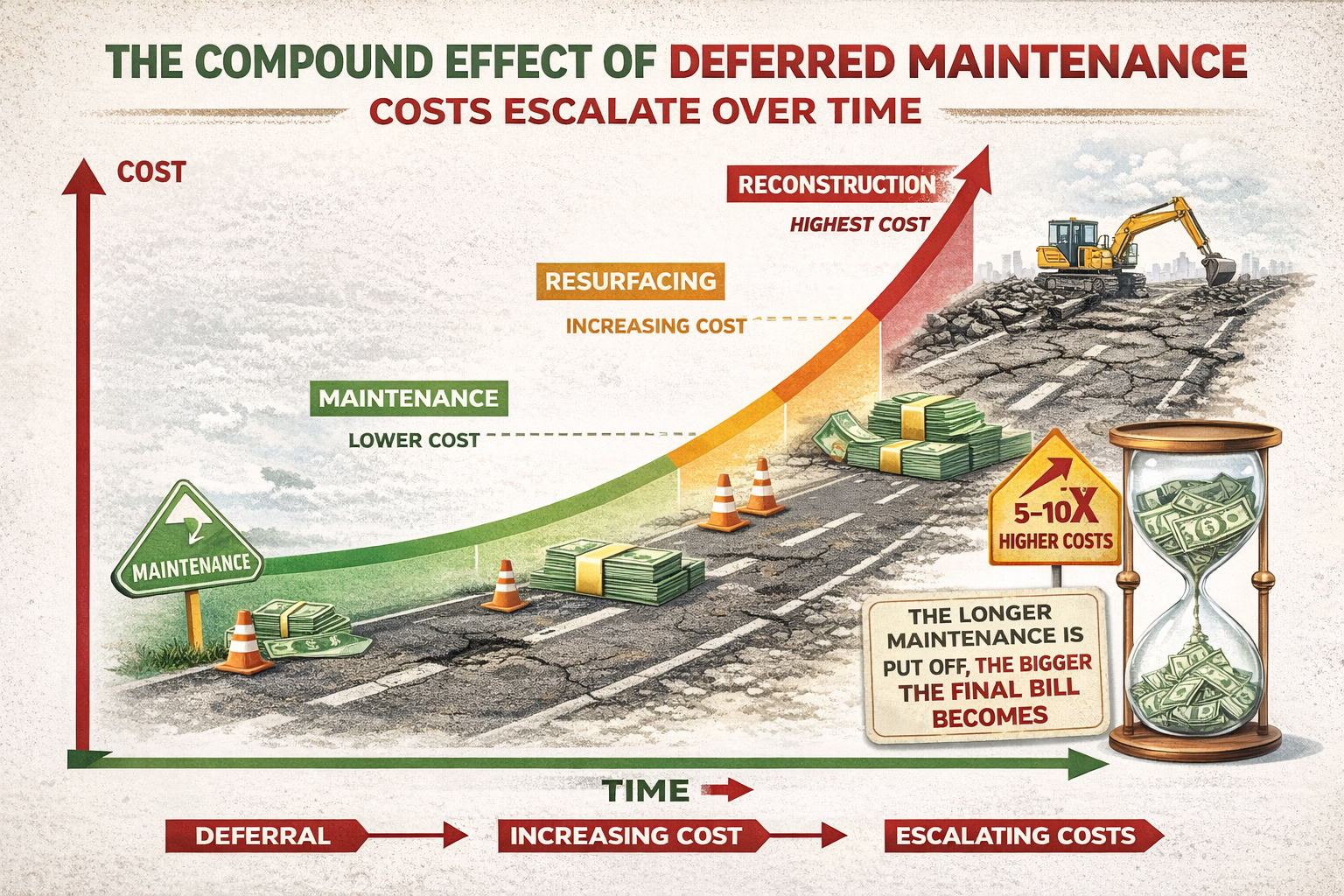
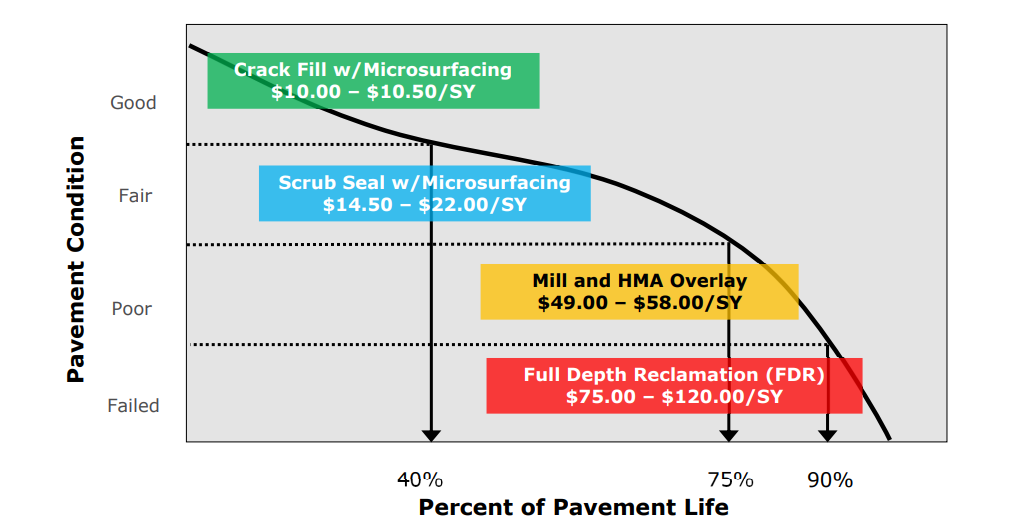
The cost of waiting is not neutral. Pavement engineers estimate that reconstructing a failed road costs six to ten times more per lane-mile than resurfacing it while it is still in fair condition. Novato's own consultant data confirms this: at current spending, the City's PCI will continue to drop, the backlog will grow, and more streets will cross the threshold from cost-effective resurfacing into full-depth reconstruction. Every year of deferral makes the eventual bill larger. A bond that costs the average homeowner $150 per year now avoids reconstruction costs that would require far higher taxes or permanently degraded roads later. The choice is not between paying and not paying. It is between paying a little now to fix roads right, or paying much more later while driving on worse streets in the meantime.
What Any Bond Must Include
Any bond Novato Stewards supports would need to be sized and sequenced to deliver visible improvements in every neighborhood, while staying disciplined about total tax burden and duration. The City should use its existing PCI data, Parks Master Plan, and facility condition assessments to build a prioritized, public project list before asking voters for a single dollar more.
Essential safeguards would include: no use of bond proceeds for ongoing operations, no diversion of funds to unrelated projects, and clear commitments about how Measure M and any future bond work together rather than overlapping or double-charging residents.
Our goal is simple: fix what we already own, protect Novato's long-term value, and stop paying more later for problems we could have solved sooner.
Our current priority is NUSD Parcel Tax Reform — read our full analysis of why the flat tax structure is failing and what a square-footage alternative would look like.